





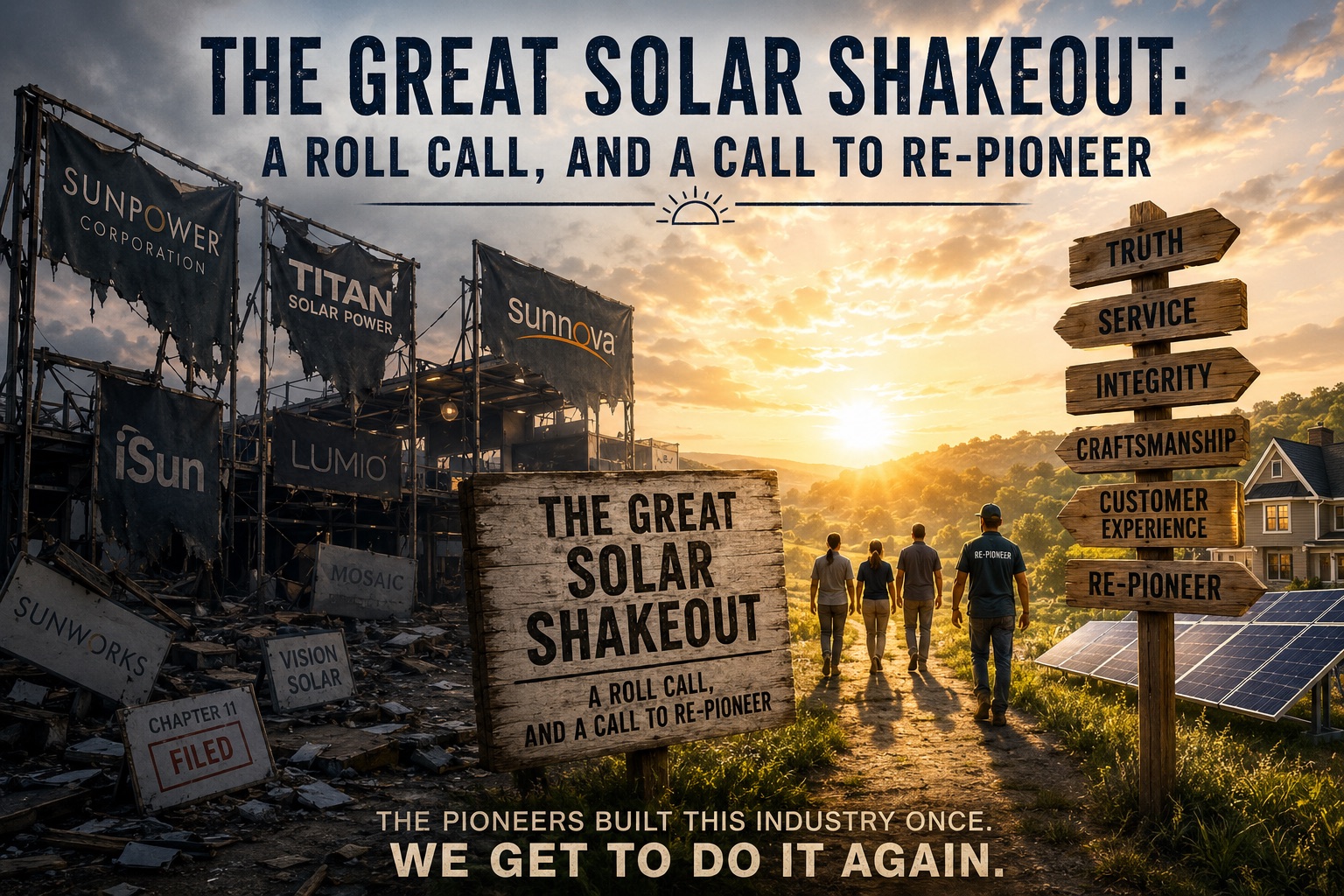
Walk the floor of any solar conference you attended three years ago, then count the empty spaces where the biggest banners used to hang. The names that once dominated our industry, the ones that bought the largest booths and made the loudest promises, are gone… or they are wearing someone else’s logo now. We are living through the great shakeout, and it is worth saying the names out loud, because an industry that refuses to look honestly at its own losses cannot learn from them.
The roll call
The list is long, and these are only the largest:
SunPower Corporation, once the most recognized name in American residential solar, filed for Chapter 11 in August 2024. The brand survives today, but under a different owner; the company that built that reputation is gone.
Titan Solar Power, one of the country’s largest residential installers, ceased operations and filed Chapter 7 in June 2024, leaving thousands of homeowners with unfinished projects and a reputation built on aggressive, dealer-driven selling.
Sunnova Energy, the Houston financing giant, filed Chapter 11 in June 2025 carrying billions in debt, cutting hundreds of jobs before winding down and handing its customers off to a successor servicer.
Lumio, a five-company roll-up that branded itself as a national platform less than four years before it failed, filed in 2024, converted to liquidation, and sold its assets for a fraction of what it raised.
iSun, the parent of the beloved Vermont installer SunCommon, went bankrupt in 2024. SunCommon itself was rescued under new ownership, a reminder that good operations can outlive bad balance sheets.
And these are joined by Mosaic, Sunworks, Vision Solar, Pink Energy, ADT’s solar division, and dozens more. By industry counts, more than one hundred solar companies filed for bankruptcy in 2024 alone, a number unseen in two decades. In California, where new net metering rules under NEM 3.0 gutted the economics overnight, rooftop volume fell by roughly eighty percent, and the California Solar and Storage Association tallied more than seventeen thousand layoffs.
Why they fell
It is comfortable to blame the weather: higher interest rates that made financed systems harder to sell, the policy whiplash of NEM 3.0, and now the end of the thirty percent federal residential tax credit, which expired for homeowner-owned systems on December 31, 2025. All of that is real, and all of it mattered.
But weather alone does not explain it. The companies that fell hardest were, very often, the ones that had built their entire model on subsidy and pressure rather than on truth and service. They sold the tax credit, not the savings. They chased volume through churn-and-burn dealer networks, overpromised, underinstalled, and left a trail of warranty claims and angry homeowners behind them. When the easy money dried up, there was no foundation underneath. The “Solar Bro” era did not die because solar stopped working. It died because that way of selling solar was never built to last.
This is not the death of solar
Here is the part the doom headlines miss. Solar still works. Utility rates keep climbing, year after year, faster than almost anything else in a household budget. The savings are slower to arrive without the federal credit, but they are still real, and for many homeowners they are larger than ever, precisely because the grid keeps getting more expensive. The federal incentive still flows through leases, power purchase agreements, and prepaid structures under the commercial credit through 2027, so the financing pathways have not vanished; they have shifted.
What died was a business model, not a value proposition. And when a broken model collapses, it clears the ground for something better.
Now is the time to re-pioneer
The first pioneers in this industry were not subsidized. They were believers. They knocked on doors when nobody understood what a panel was, they earned trust one roof at a time, and they built an industry on conviction and craftsmanship. Somewhere along the way, too many companies traded that pioneering spirit for a growth-at-all-costs spreadsheet.
The shakeout has handed the survivors something valuable: a market with less noise, fewer predators, and customers who are hungry for someone honest. This is the moment to re-pioneer. To rebuild on the things that actually endure: telling homeowners the truth about their math, treating every single lead like it matters because now it truly does, answering the phone after hours when families are finally home, and keeping the customer experience intact even while running lean. The companies still standing in 2028 will not be the ones who shouted the loudest. They will be the ones who served the best.
The pioneers built this industry once on belief and integrity. We get to do it again, on purpose this time.
If you are rebuilding, you do not have to carry the weight alone
At Solar Inside Sales, this is the work we were built for: turning the leads you already have into booked appointments and real revenue, nurturing the slow ones with patience instead of pressure, and keeping your phones answered and your pipeline moving without the fixed payroll that sank so many of the companies above. Lean, ethical, and converting at rates that double and often triple the industry, so you can grow through the downturn instead of being buried by it.
If you are ready to re-pioneer, let’s talk: solarinsidesales.youcanbook.me
Cori Kennedy is the founder of Solar Inside Sales, where the mission is simple: highest lead conversion in the industry, built on service, not pressure.